A lifetime of living in and experiencing rural Maine, a book by a French phenomenologist, and 14th- and 15th-century paintings he saw while studying in Florence have shaped Alan Bray into an artist who paints the unseen essence of the perceived landscape. The Maine essayist and art critic, Edgar Alan Beem declared, “Alan Bray is the visual poet laureate of nature, reclaiming central Maine even as man attempts to suburbanize it. His vision of Maine is the best and the purest I have seen.”
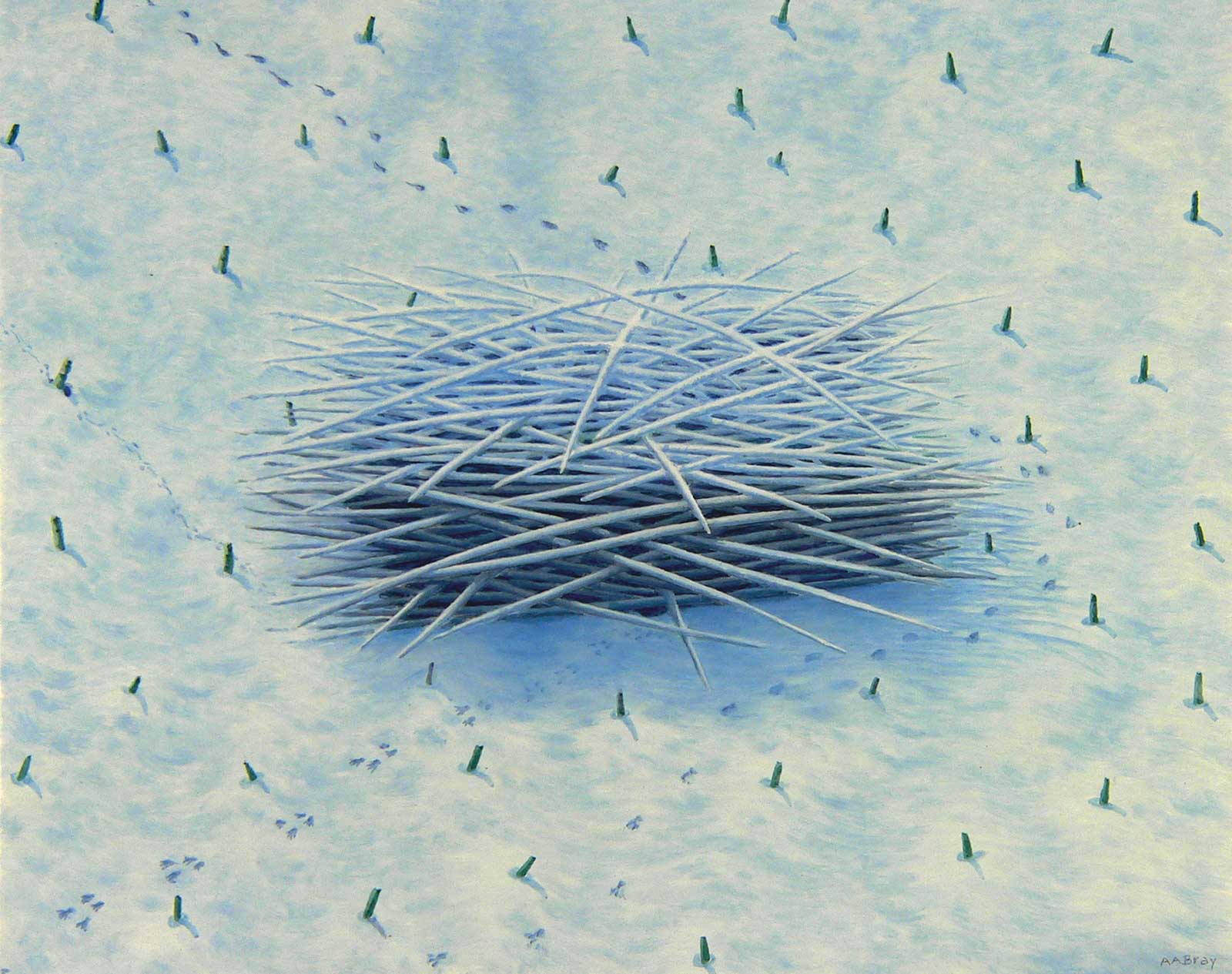
Refuge, 2024, casein on panel, 16 x 20”
The Poetics of Space by Gaston Bachelard (1884-1962) is one of Bray’s favorite books (and was my favorite in architecture school). Bray remarks that it “just totally turned me upside down and changed my life in the sense that it gave me a way to look at the natural world that didn’t have much to do with scenery, and it wasn’t about finding a pretty scene. Instead, it was like looking at natural phenomena, and studying that, and finding the form and the structure and the processes that are involved in what you’re actually looking at. That just completely opened me up…I’m not looking at scenes. I’m looking at natural phenomena, and then I either find or invent a scene that will help me to explicate that.”
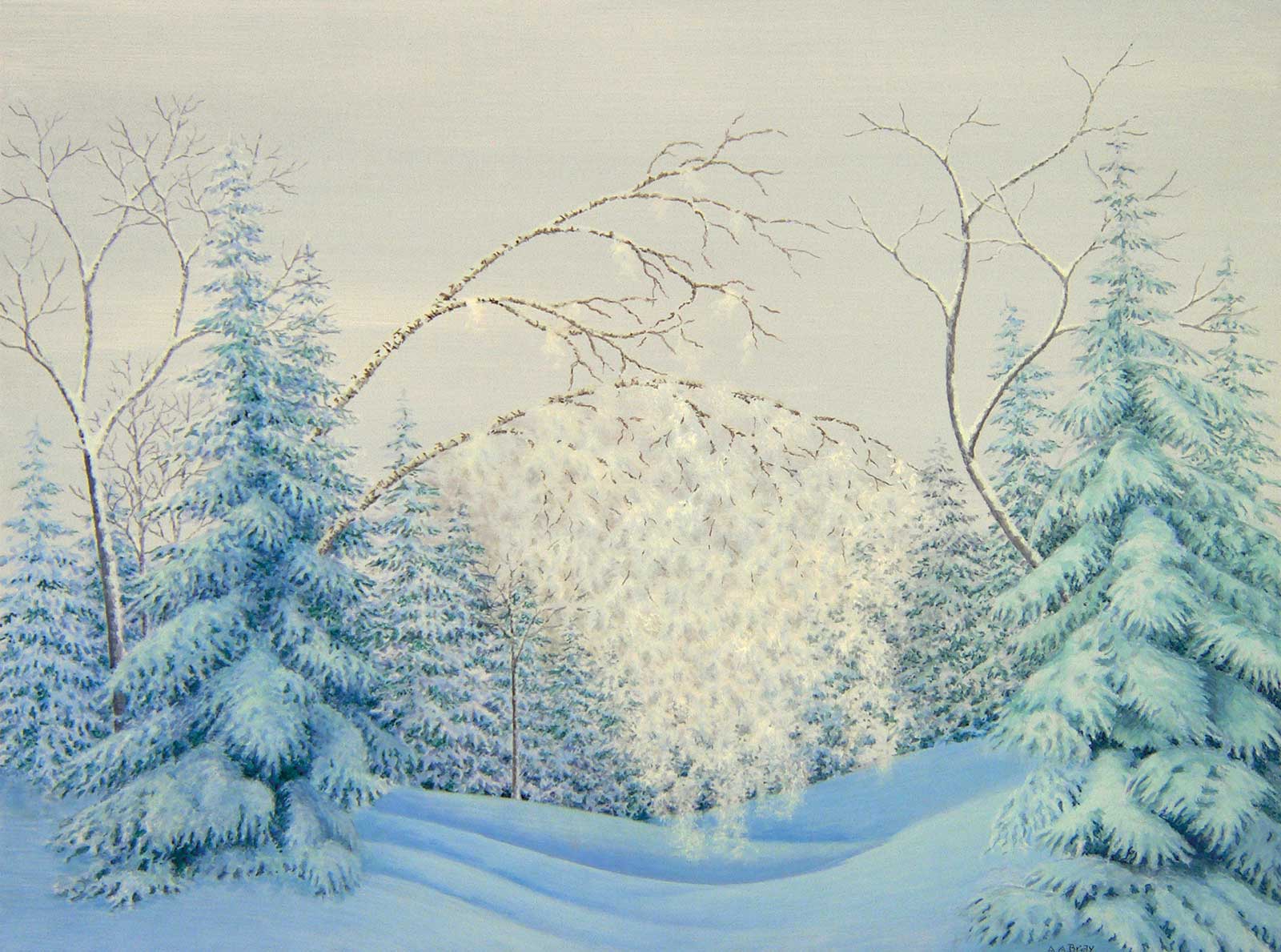
A Whisper Breaks the Silence, 2024, casein on panel, 15 x 20”
Bachelard wrote, “For our house is our corner of the world. As has often been said, it is our first universe, a real cosmos in every sense of the word. If we look at it intimately, the humblest dwelling has beauty.”
Bird nests, mouse burrows and farmhouses are all part of the landscape, and all are worthy of observation and study. All appear in Bray’s paintings. Alan Bray: Inhabited Landscapes,is an exhibition of his recent paintings that opens at DFN Projects in New York City on April 30. It is Bray’s fourth solo exhibition with Garvey | Simon. Elizabeth Garvey and her sister Catherine Simon founded the gallery in 2010. Garvey was co-director with Penny Schmidt of Schmidt-Bingham Gallery in New York when I borrowed a Bray painting for an exhibition at the Arnot Art Museum in 1997. In 2001 we were able to purchase one of his paintings for the permanent collection.
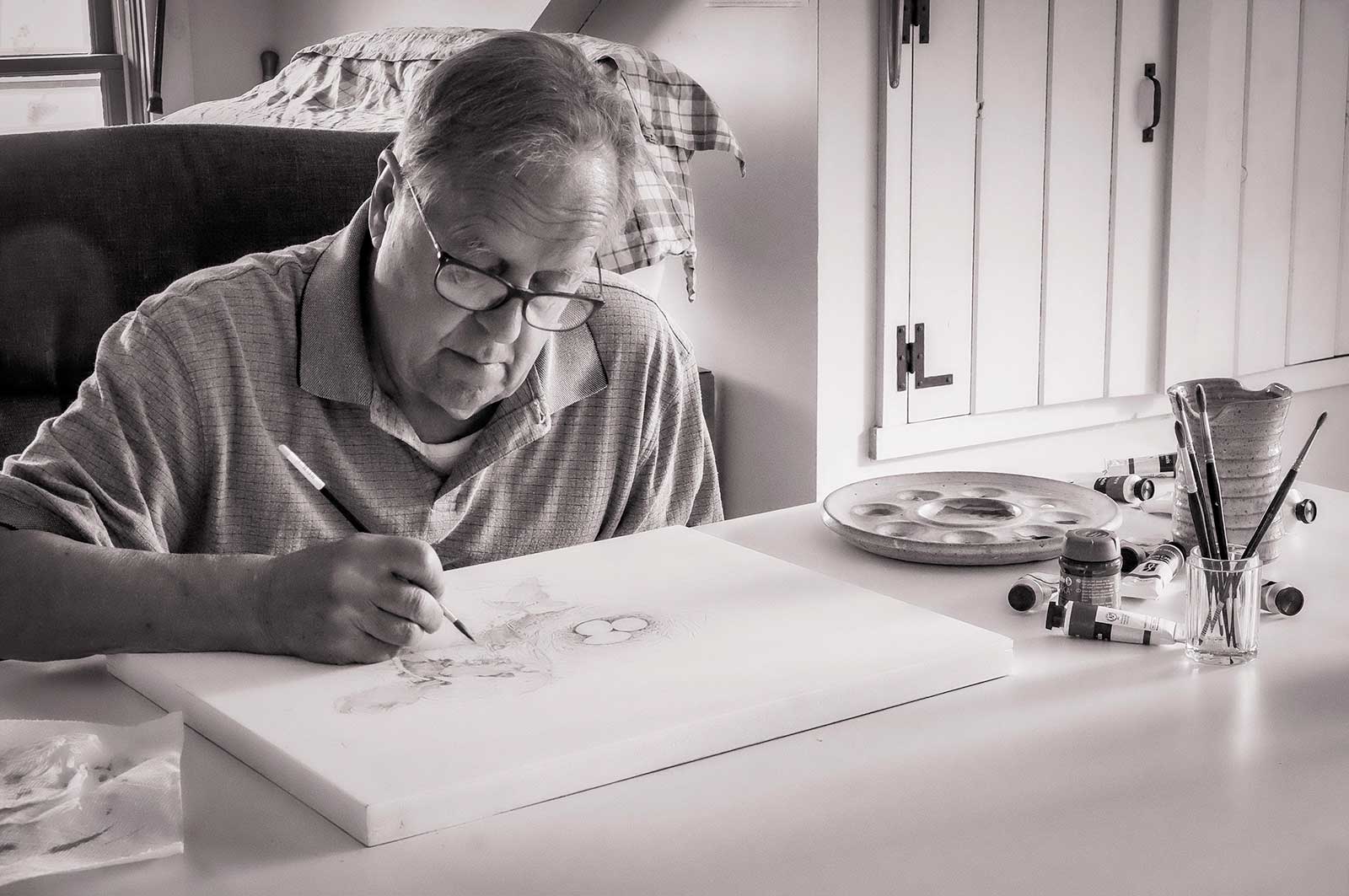
Alan Bray working on his painting Hermit Thrush. Photo by David Etnier. Courtesy the photographer.
Bray grew up in Monson, Maine, immersed in the life of the outdoors—camping, hiking, fishing, climbing. He recalls being a “prodigious builder of things,” like rafts and lean-tos. “If you didn’t have it,” he says, “you made it.” He and his friends even built their own baseball field. He often spent summers in Hyde Park, Massachusetts, a suburb of Boston where he could attend Red Sox games at Fenway Park and visit the Museum of Fine Arts. “It was the first time I saw real art,” he says. “I was blown away by Monet. I started making drawings and copying things but there was no reason to pursue art as a career.”
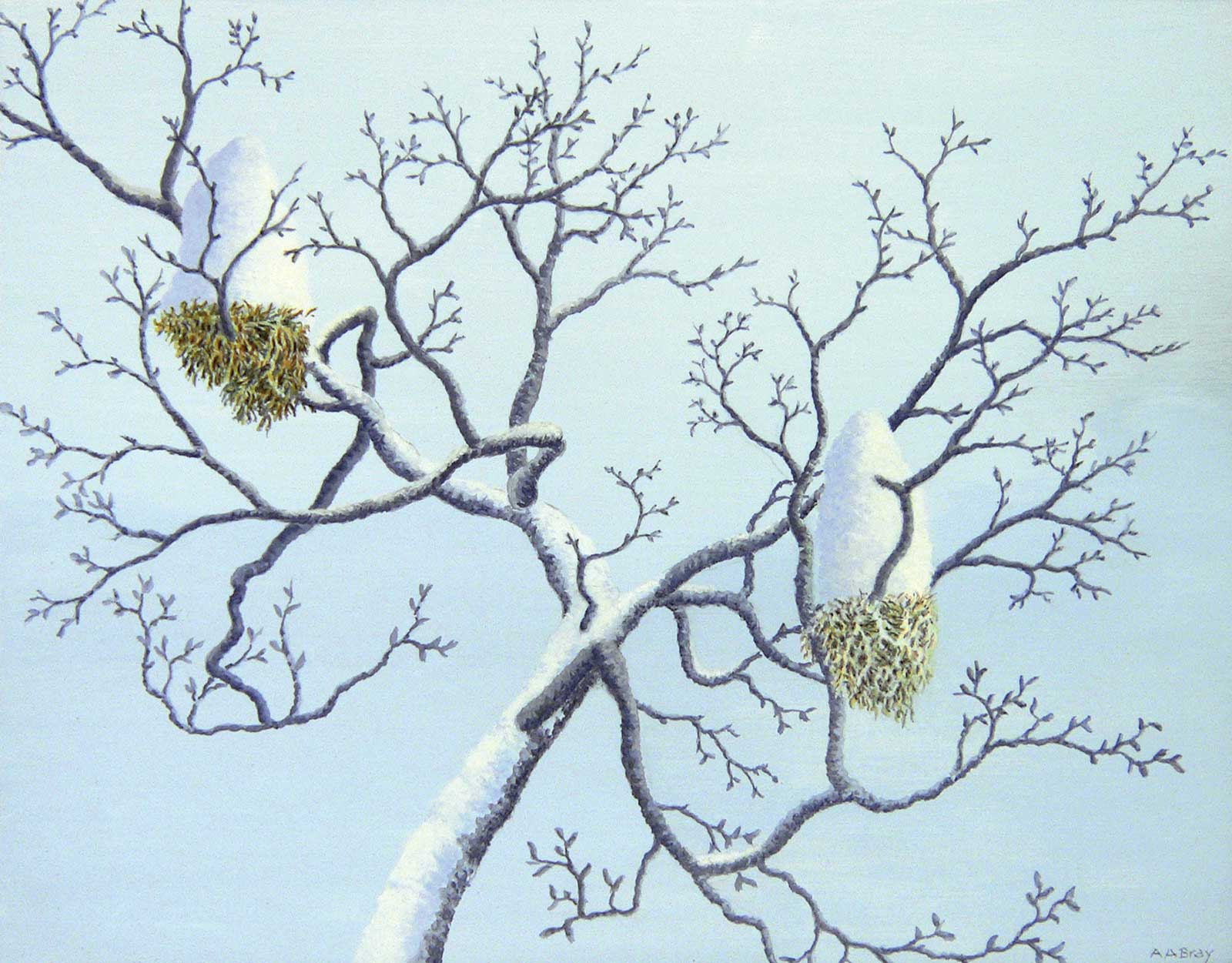
Neighbors, 2025, casein on panel, 11 x 14"
He was good enough at baseball to receive a scholarship to Thomas College in nearby Waterville, Maine. When he told the president of the college that he really wanted to go to art school despite the fact that his friends thought it was a stupid idea, the college president thought it was a great idea. His girlfriend, now his wife of 60 years, Diana, “applied to schools on my behalf. I was accepted to the Art Institute of Boston, which was then the School of Practical Arts, which we called the ‘School of Practically Arts.’ It gave me a chance to catch up on basic things like perspective and figure drawing.”
He later received his bachelor of arts in art education at the University of Southern Maine. While there, he was encouraged to attend the Villa Schifanoia graduate school of fine arts in Florence, Italy, where he later received a master of fine arts in painting.
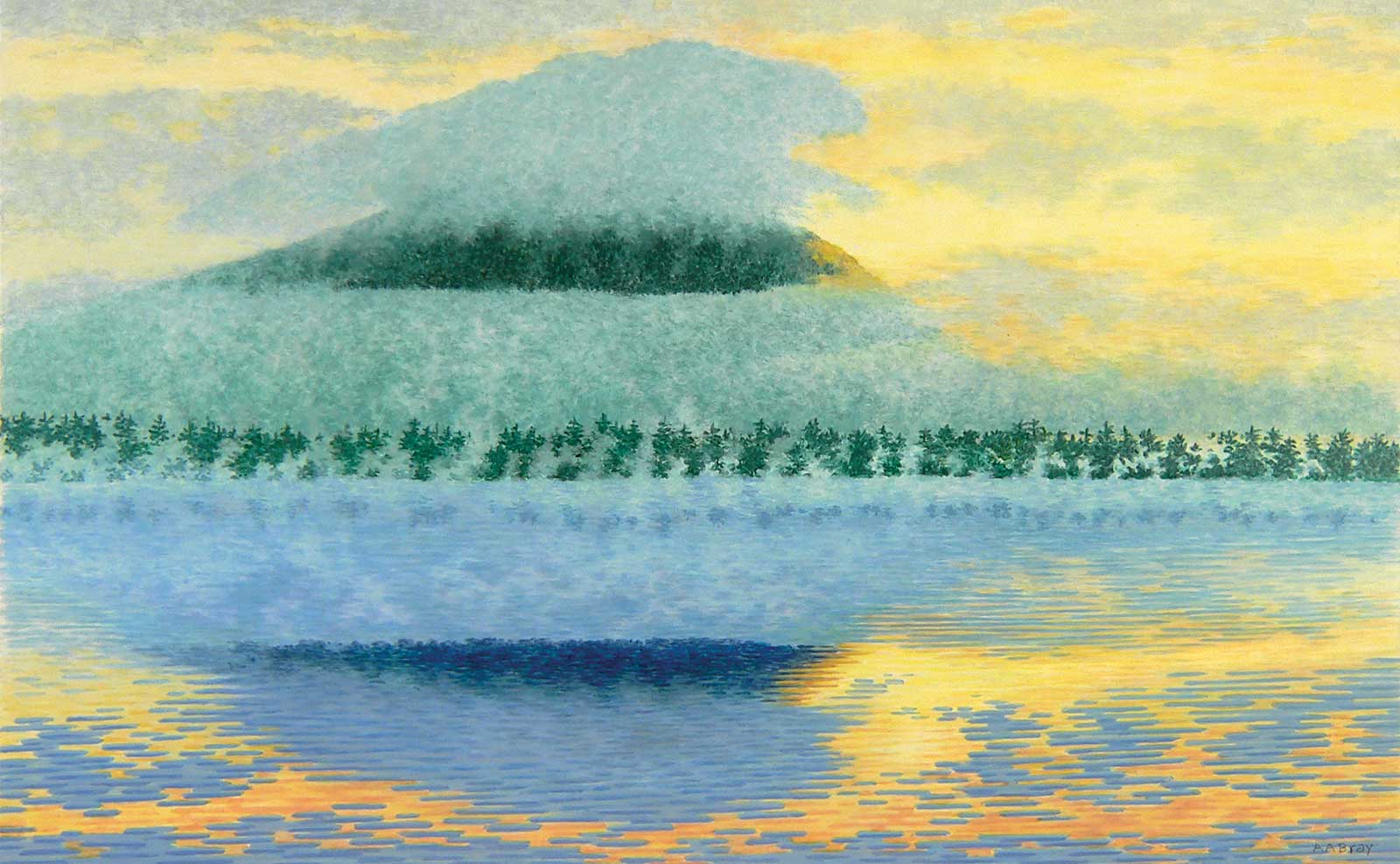
First Light, 2024, casein on panel, 15 x 24"
“We were young and stupid and just up and went with one-way tickets,” he recalls. “But I fell in love with Gothic painting and the work of Lorenzetti, Fra Angelico, Simone Martini, Giotto and others of that time. It was partly the unexpected qualities of pure primary colors, hard edges, the rudimentary perspective and the resulting compositional inventiveness that looked so modern and so alluring to me.” He also began painting in casein on panel. Casein is a milk-based tempera that dries quickly and demands short quick brushstrokes built up in layers.
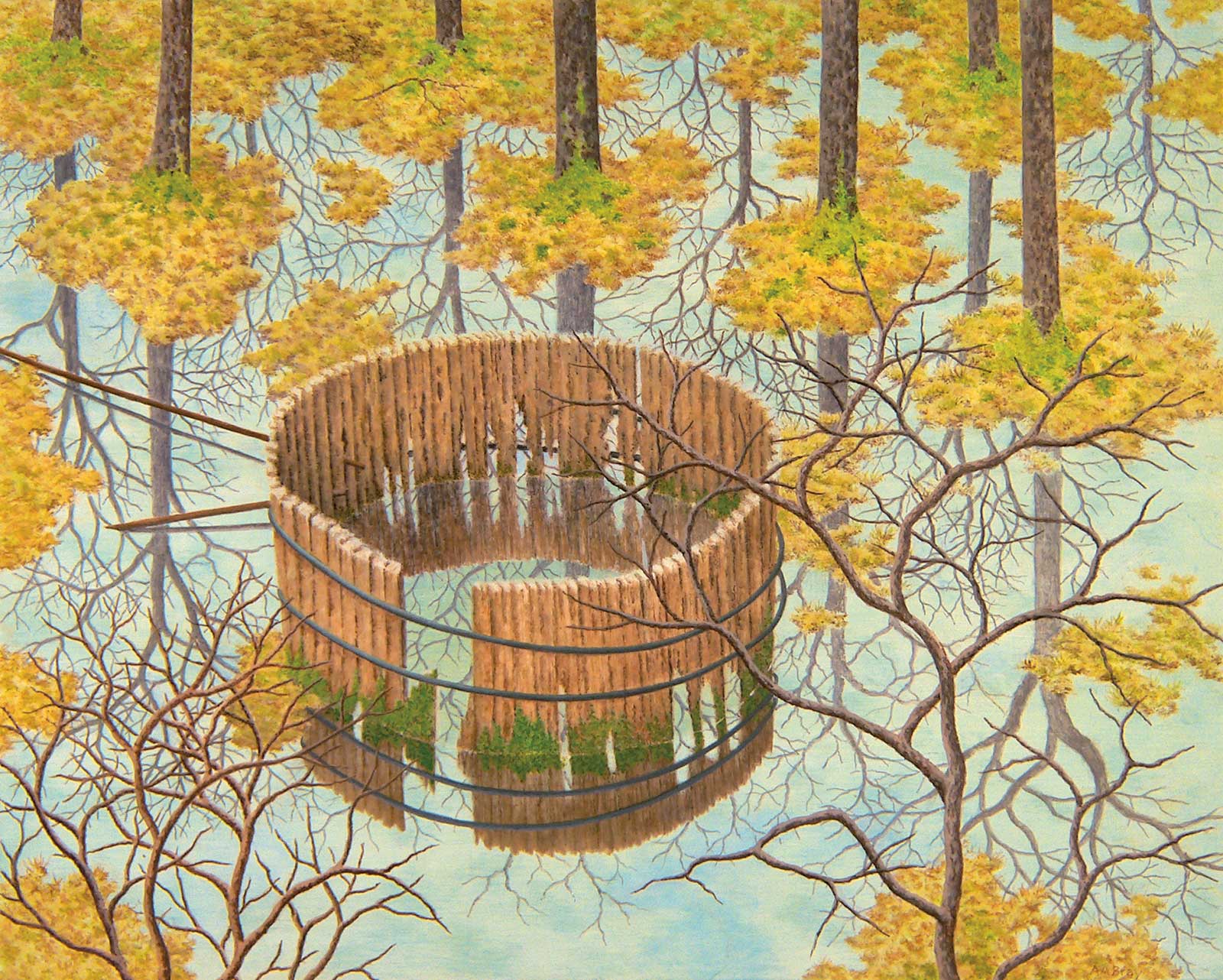
Relic, 2023, casein on panel, 16 x 20"
He has included several birds’ nests from his collection in the current exhibition, the brushstrokes often emulating the delicate construction of the nests. In Neighbors,2025, he depicts nests in a magnolia tree right outside his living room window. “The one on the left is a robin’s nest, and I watched it being built this past spring. I have a chair under the tree and the robin made a fuss every time I sat there but did not abandon it. The other nest is only 24 inches from the window, but I only became aware of it when the leaves dropped away. It is either a vireo nest or a redstart. They are very clever and secretive builders. The robin’s nest is crude, made by a young robin. After a snowstorm, two tall peaks piled up on the nests.”
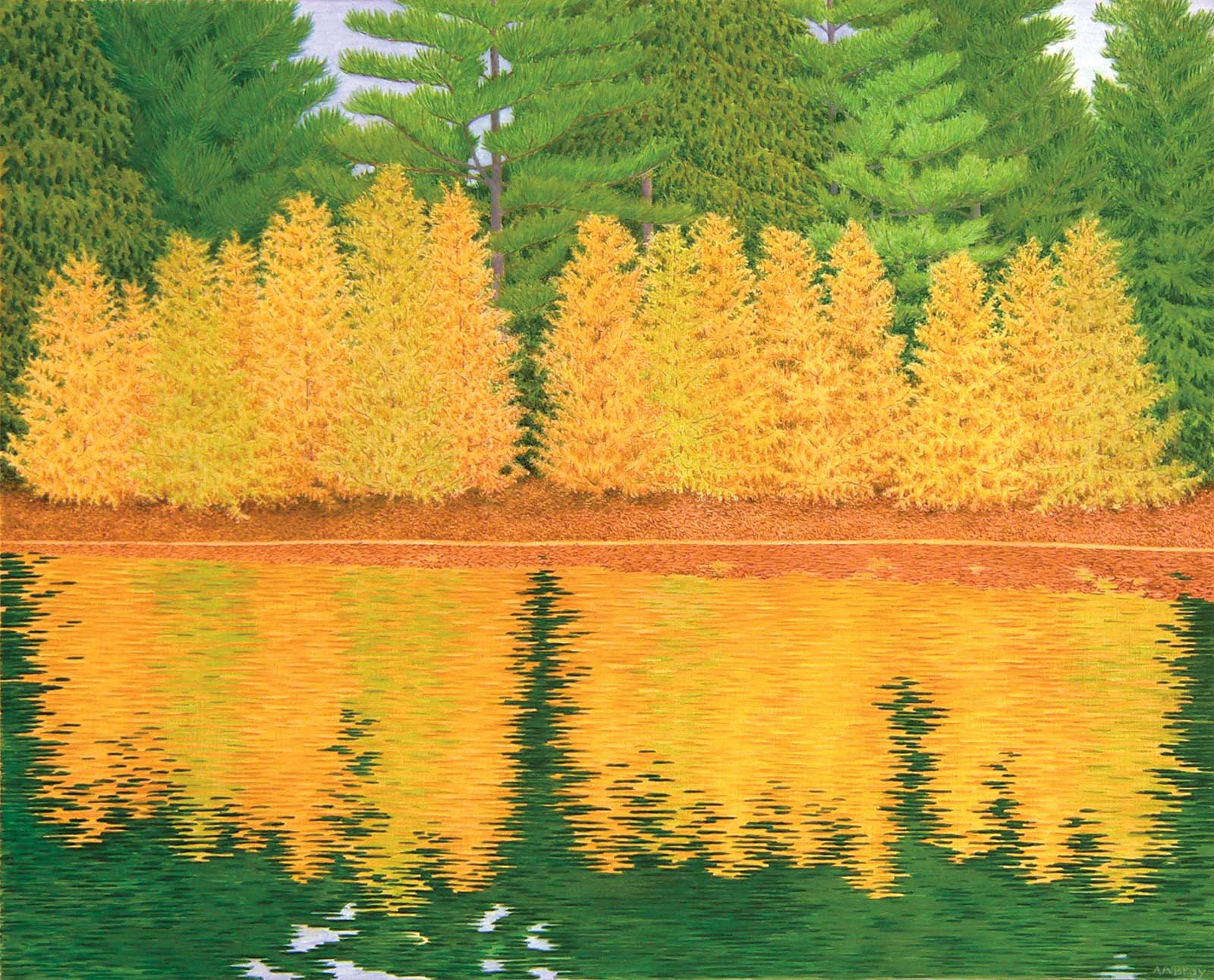
Larch, 2021, casein on panel, 16 x 20"
“Refuge is a brush pile in the deep winter,” he says. “A fox had checked it out and scared off a squirrel and had given chase (at least that was my assessment of the scene).” The scene is an aerial view, looking down from above, his favorite point of view. There are ephemeral moments in nature that become lasting memories and, in the case of artists of all kinds, a bit of poetry, a passage of music or a painting. A Whisper Breaks the Silence is one of those paintings.
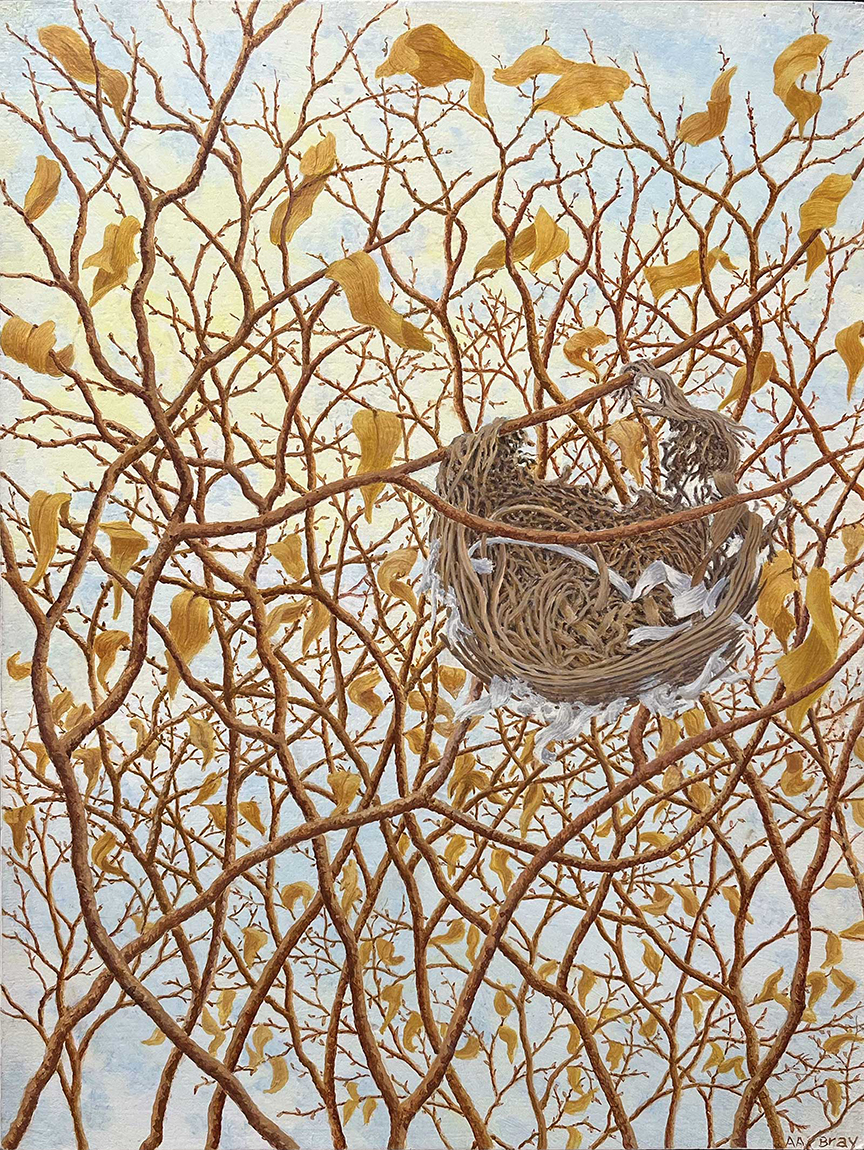
Windblown, 2023, casein on panel, 12 x 9"
“The snowy painting,” he comments, “is from a magical moment when after a big storm I was snowshoeing on a woods’ road and a birch tree suddenly shed its load of snow and sprang back into the air. It made the faintest sound in the otherwise silent woods.”
He explains, “A reflection is not simply a mirror image.” In Larch, 2021, the yellow trees, evergreens and blue sky are reduced to fields of color in the rippling water. In First Light,2024, a scene on his beloved Spencer Pond where he escapes with his buddies of many decades, he has allowed the reflection to dissolve into pixels.
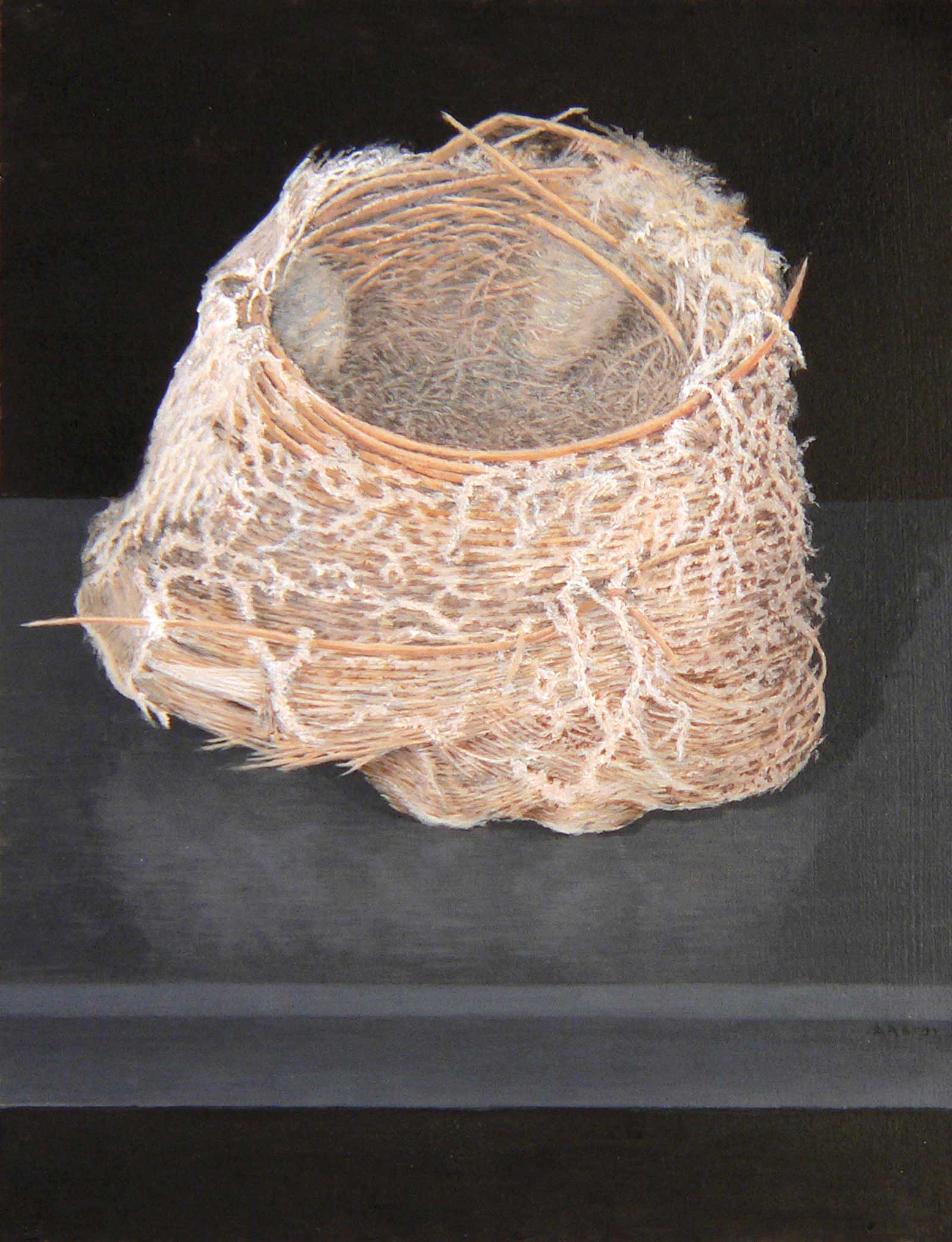
Nest in a Nest, 2023, casein on panel, 12 x 9"
Water appears often in his paintings. He reiterates that Bachelard gave him “a different way to think about the landscape, looking at natural phenomena. I could sit and watch water for a day.”
The French writer recorded his own similar response to water, in “Water and Dreams: An Essay on the Imagination of Matter.” “I was born in a country of brooks and rivers, in a corner of Champagne, called Le Vallage for the great number of its valleys. The most beautiful of its places for me was the hollow of a valley by the side of fresh water, in the shade of willows...My pleasure still is to follow the stream, to walk along its banks in the right direction, in the direction of the flowing water, the water that leads life towards the next village...Dreaming beside the river….”.
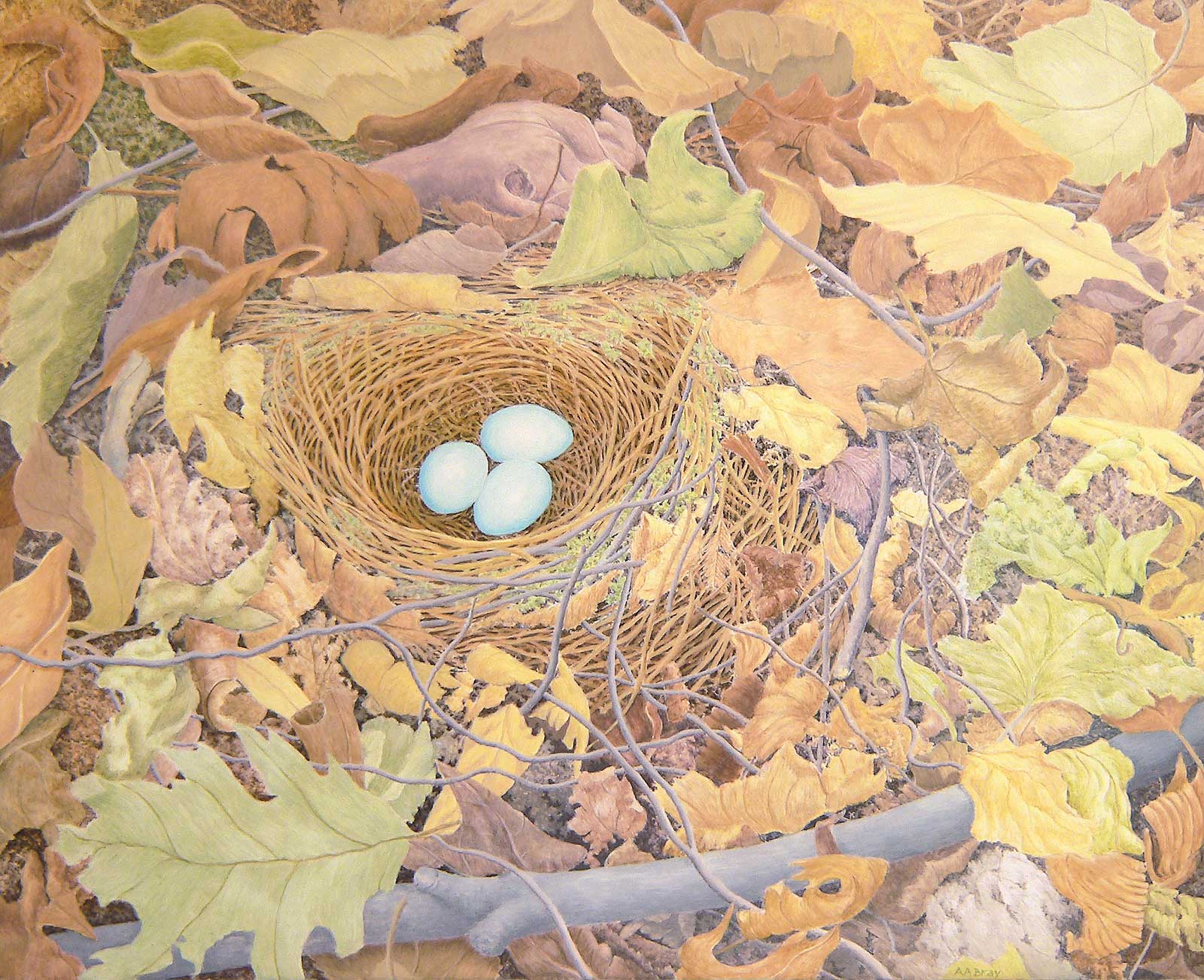
Hermit Thrush, 2022, casein on panel, 16 x 20"
Bray acknowledges “a great reverence for nature in a general sort of way—not philosophical or intellectual.” He agrees with Bachelard who wrote, “There is no word for the sense that you are a part of what you are looking at.” —
Alan Bray: Inhabited Landscape
April 30-May 30, 2025
Garvey | Simon at DFN Projects
16 E. 79 Street, New York, NY 10075
(917) 796-2146, www.garveysimon.com
Powered by Froala Editor